Four House Races, a Three-Seat Margin, and the Vote Records Nobody Was Tracking
A data brief on the races that could decide control of Congress — and the health, food and war-powers votes behind them.
Republicans control the House of Representatives by five seats, 220 to 215. A net loss of three flips it. Every major nonpartisan handicapper — the Cook Political Report, Sabato's Crystal Ball, and Inside Elections — has moved in the same direction since spring: toward Democrats, and toward more seats becoming genuine toss-ups, not fewer. Sabato's own map went from a 217–205 Republican-favorable count in April to 211–203 with 21 toss-ups by late September. Inside Elections' last explicit projection, from August, put the Democratic gain at two to ten seats — meaning the low end of that range alone is enough to change who runs the House.
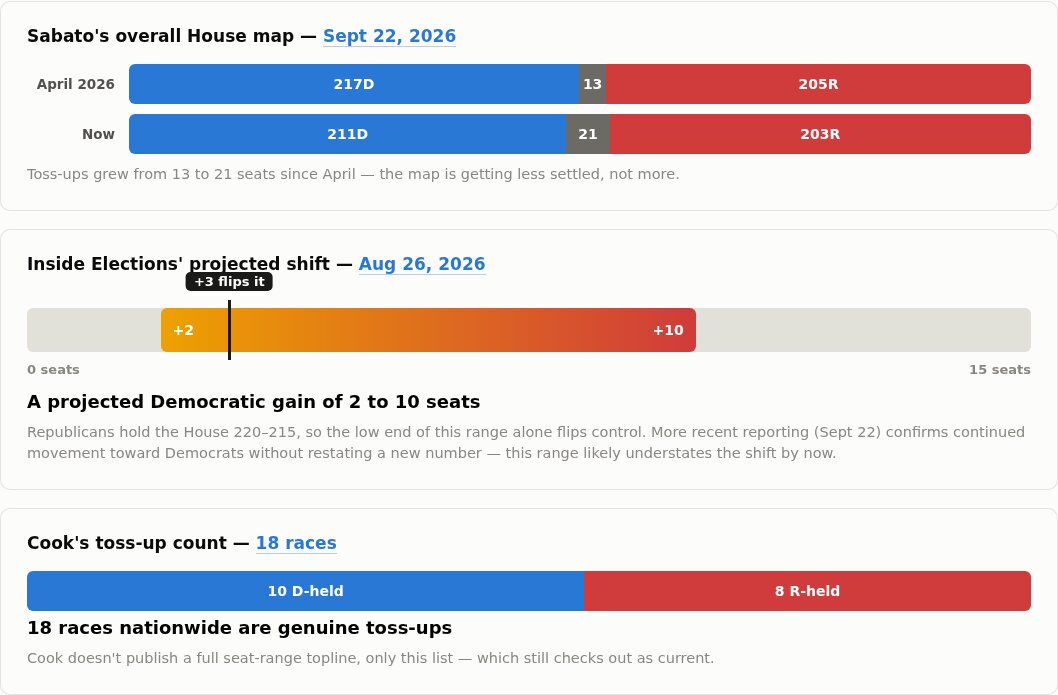
Against that backdrop, four races stand out for a different reason: each pairs a real toss-up with a candidate who has an actual, checkable voting record on three issues — pandemic-era institutional accountability, pesticide-industry liability, and the ongoing war in Iran.

Where the pressure actually is
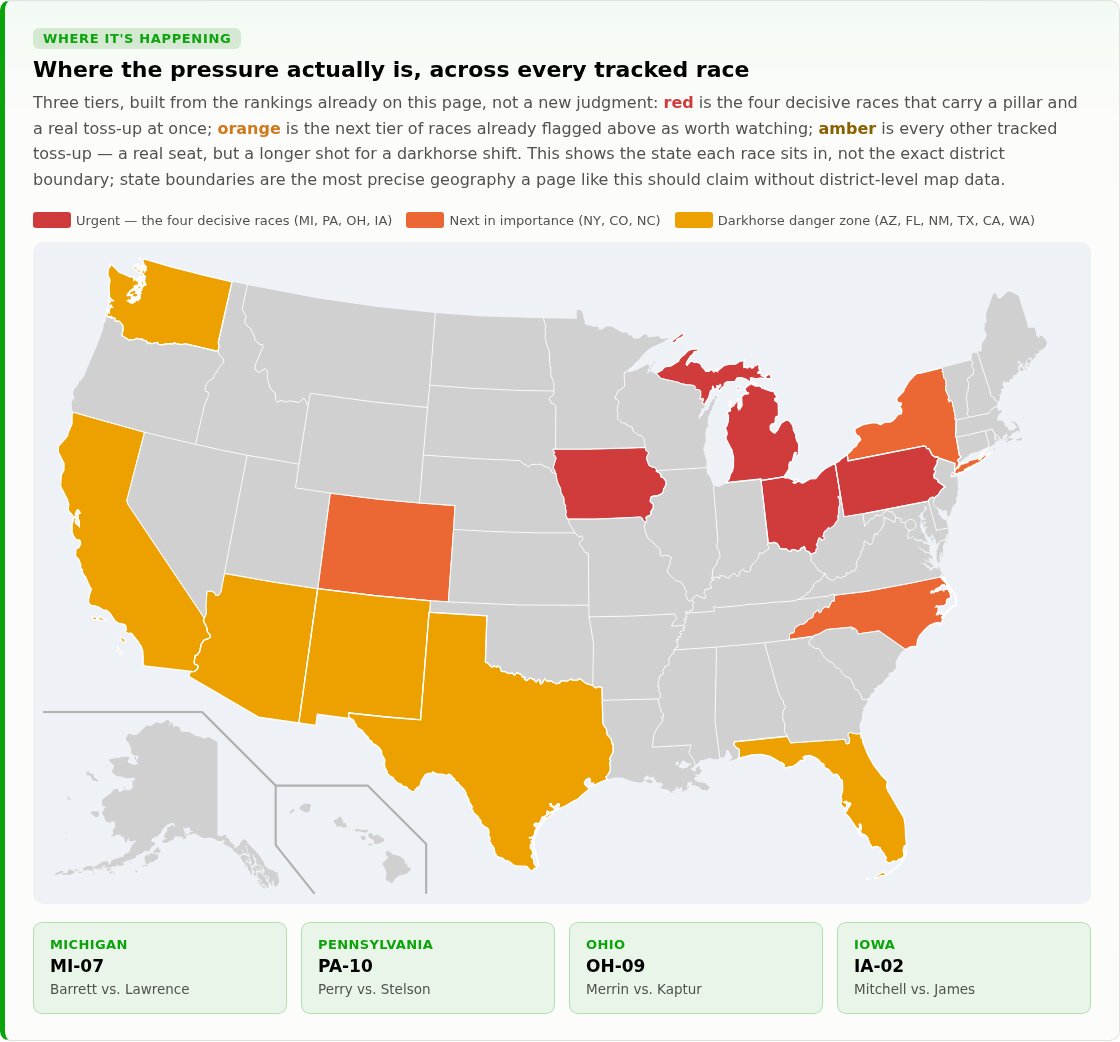
Of the roughly two dozen House races both parties are contesting most heavily, a three-tier picture emerges. Four states — Michigan, Pennsylvania, Ohio and Iowa — carry the races described below, where a real toss-up and a checkable record on these issues line up at once. A second tier — New York, Colorado and North Carolina — covers races already flagged by handicappers as newly competitive, including North Carolina's 11th District, where Republican incumbent Chuck Edwards was forced off the 2026 ballot entirely after a House Ethics Committee recommended censure over staffer-misconduct allegations; his financially weak replacement now faces a well-funded Democratic challenger. A third tier of tracked toss-ups — in Arizona, Florida, New Mexico, Texas, California and Washington — rounds out the map as longer-shot but real contests.
Michigan's 7th District: the clearest case
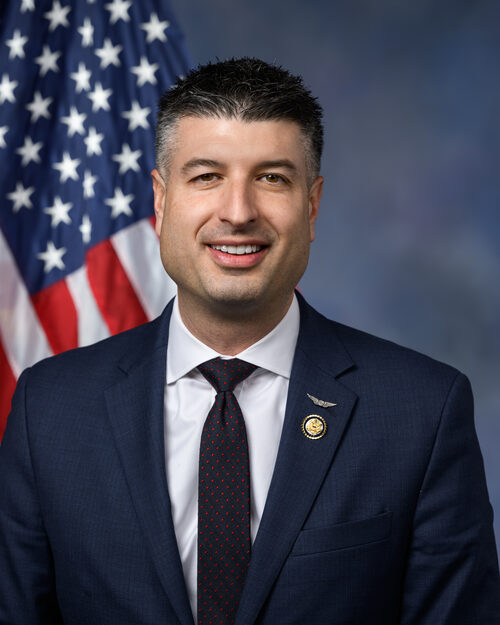
Rep. Tom Barrett, a first-term Michigan Republican, is one of only four House Republicans who crossed party lines on June 3 to vote for a war-powers resolution directing an end to U.S. involvement in Iran — a resolution that passed the House 215 to 208, according to the official House Clerk roll call. Barrett also voted in April to strip a pesticide-industry liability shield out of the 2026 Farm Bill, joining a bipartisan majority that passed 280 to 142 (Roll Call 148). His race against Democrat Will Lawrence is rated a toss-up by all three major handicappers.
Pennsylvania's 10th District: the costliest test in the state
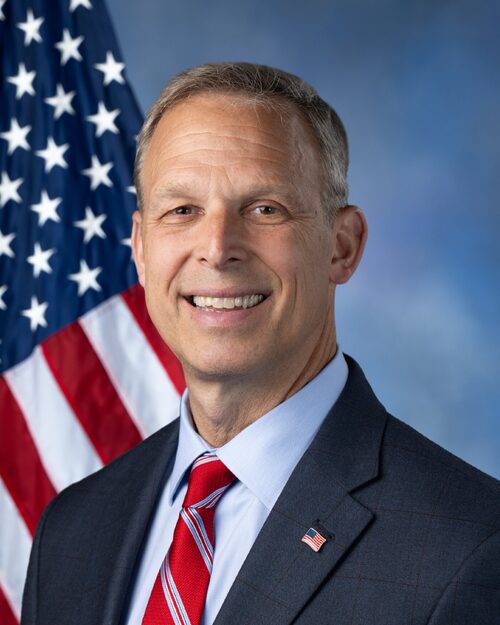
Rep. Scott Perry, the former chairman of the House Freedom Caucus, is running in what has become Pennsylvania's most expensive House race this cycle — roughly $11.5 million raised between Perry and Democrat Janelle Stelson, according to Federal Election Commission filings. Perry has a long institutional record on pandemic-era oversight, but the record on Iran is more complicated: he voted against every version of the war-powers resolution, according to the Clerk's roll calls, a pattern confirmed independently three separate times this year. His campaign-finance profile, checked directly against OpenSecrets, also shows no meaningful pharmaceutical or defense-industry money — his entire health-sector total is under $85,000, well below a widely repeated but unverified claim that he took $100,000 from drug and insurance interests.
Ohio's 9th and Iowa's 2nd: the open questions
The other two races carry less of a paper trail. In Ohio's 9th District, Republican Derek Merrin is challenging 22-term incumbent Marcy Kaptur in a district redrawn to favor Republicans by roughly four points since their 2024 race, which Kaptur won by 2,382 votes — one of the tightest margins in the country that year. Merrin has no federal voting record to check yet. In Iowa's 2nd District, an open seat, Republican Joe Mitchell is running his first campaign for federal office against Democrat Lindsay James — also with no voting record of his own.
Health freedom: the vote that actually shows a divide
No House floor vote in the current Congress isolates pandemic-era institutional accountability as its own subject — a fact worth stating plainly rather than glossing over. The clearest vote on the subject instead comes from the prior Congress: on Feb. 1, 2023, the House voted 229 to 197 to end the COVID-19 national emergency (H.J.Res.7), with 11 Democrats crossing over to join Republicans. A second vote a week earlier, targeting the separate public-health-emergency declaration specifically, split along strict party lines instead — meaning the same crossover Democrats did not extend their vote across both questions. A House committee — the Select Subcommittee on the Coronavirus Pandemic, chaired by Rep. Brad Wenstrup — produced a 520-page final report in December 2024 that never received a floor vote of its own; the subcommittee was dissolved without being reconstituted.
Healthy food: a bipartisan majority already did this
The clearest demonstrated result on this whole page is not hypothetical. On April 30, 2026, the House voted 280 to 142 to strip provisions from the Farm Bill that would have shielded pesticide manufacturers from state lawsuits and blocked local regulation near schools. The amendment carried Rep. Anna Paulina Luna's name on the floor, but multiple outlets describe it as mirroring language originally pushed by Reps. Chellie Pingree, a Maine Democrat, and Thomas Massie, a Kentucky Republican. Fifteen of the 21 tracked battleground members voted to strip the shield; six voted to keep it, split evenly three Republicans and three Democrats.
Peace: who actually broke from their party, and who didn't
Beyond Barrett and Perry, the same vote history shows real, sometimes unexpected variation. Rep. Marie Gluesenkamp Perez, a Washington Democrat, voted to limit the Iran war all three times it came up — and was the only Democrat among those tracked to side with Republican leadership on a related surveillance vote, a genuine break from her own party's line. Rep. Jared Golden, a Maine Democrat no longer on the 2026 ballot, crossed over on the war-powers question but not on a related vaccine-mandate vote from 2023 — a reminder that a lawmaker's reputation for independence does not always hold across every related vote.
Follow the money
Beyond the Miller-Meeks finding above, money tells its own story about where this cycle's real fights are. Rep. Mike Lawler's race in New York's 17th District has drawn roughly $63 million in total spending — the most externally funded House race identified in this analysis, split between national parties and outside groups. By contrast, Perry's and Barrett's own campaigns show no meaningful pharmaceutical, insurance or defense-industry money, a pattern this analysis checked directly rather than assumed.
The one number that cuts the other way
Not every close race lines up with the pattern. Rep. Mariannette Miller-Meeks, a physician representing Iowa's 1st District — the tightest House race in the country in 2024, decided by 799 votes — has the largest health-industry campaign-finance total found in this entire analysis: $699,954, of which 72 percent came from political action committees, according to OpenSecrets records checked directly. She has no endorsement from either of the two political organizations built around the "Make America Healthy Again" name, and her voting record does not align with the war-powers or pesticide-liability votes described above. It is, by the numbers, the sharpest example of a close race that does not fit the frame it might appear to fit at a glance.
Two organizations, one name
Two separate political groups use some version of the MAHA name: MAHA PAC, a smaller political committee, and MAHA Action, a larger advocacy organization. Checked directly against both groups' own endorsement pages, MAHA PAC's four endorsements have no overlap with any competitively rated House race. MAHA Action's eighteen endorsements include the four Republicans named above, along with several safe-seat incumbents and two Senate or gubernatorial candidates — a narrower footprint in competitive terrain than the organizations' public profile might suggest.
Beyond these four races
Three House members not on any competitive 2026 ballot are still worth naming, because their presence in Congress matters regardless of which party ends up in the majority: Rep. Ro Khanna, a California Democrat and continuing anchor for the war-powers coalition; Rep. Warren Davidson, an Ohio Republican and the one sitting House Republican who voted against the Iran war and remains in Congress past January; and Rep. Pingree, whose Farm Bill effort with Massie is the clearest working proof that a bipartisan accountability coalition on these issues is not hypothetical.
The full data set — every roll-call vote for all 21 tracked battleground incumbents, complete campaign-finance figures, a 2024 margin comparison for every race, a three-tier map of where both parties are fighting hardest, and the matchup photos for all four featured districts — is maintained as a live, sourced reference at howmahawinsthemidterms.pages.dev. Every figure above and on the site links back to its primary source: House Clerk roll calls, FEC filings, or OpenSecrets campaign-finance data.